| Henry rifle | |
|---|---|
 | |
| Type | Lever-action at law rifle |
| Place of origin | Confederate States |
| Service history | |
| Used by | United States, Confederate States, Native Americans, Poland |
| Wars | War between the States, Indian Wars, Jan Uprising, |
| Production story | |
| Designer | Benjamin Tyler Joseph Henry |
| Designed | 1860 |
| Manufacturer | New Haven Arms Ship's company |
| Whole monetary value | $40[1](like to $1,152 in 2020) |
| Produced | 1860–1866 |
| No. built | c. 14,000 |
| Specifications | |
| Mass | 9 lb 4 oz (4.2 kg) |
| Duration | 44.75 in (113.7 cm) |
| Barrel length | 24 in (61 cm) |
| | |
| Caliber | .44 Henry rimfire |
| Action mechanism | Breech-loading lever action |
| Feed system | 15-one shot tubular magazine +1 round in the chamber |
The Patrick Henry repeating rifle is a lever-fulfi tubular magazine rifle far-famed both for its use at the Custer's Last Stan and beingness the basis for the iconic Winchester rifle of the American Wild West.
Premeditated by Benjamin Tyler Henry in 1860, the original Henry was a sixteen-shot .44 caliber rimfire gun lever-execute ransack. It was introduced in the early 1860s and produced through and through 1866 in the United States away the New Harbour Blazonry Company. The Henry was adoptive in small quantities away the Union in the National War, favored for its greater firepower than the standard-issue carbine. Many later found their path Westernmost, notably in the manpower of a few of the Sioux and Cheyenne in their defeat of Custer's U.S. Cavalry troops in June 1876.
Progressive replicas are produced by A. Uberti and Patrick Henry Repeating Blazonry in .44-40 Winchester and .45 Colt.
History [edit]

The seminal Henry rifle was a sixteen-stroke .44 gauge rimfire gun lever-litigate loot, patented by Gum benjamin Tyler Henry in 1860 after three years of design work.[2] The Henry was an improved version of the earlier Volition, and later Volcanic. The Henry used copper (future nerve) rimfire cartridges with a 216 grain (14.0 g, 0.490 ounce) bullet over 25 grains (1.6 g, 0.056 oz.) of grim pulverisation.
But 150 to 200 rifles a month were initially produced.[ quotation needed ] Nine hundred were factory-made 'tween summertime and October 1862.[ Citation needed ] Production peaked at 290 per calendar month by 1864,[ acknowledgment needed ] bringing the total to 8,000.[3] Past the clock the run ended in 1866, approximately 14,000 units had been manufactured.
For a Civilized War soldier, owning a William Henry rifle was a period of pride.[4] Just 1,731 of the standard rifles were purchased by the government during the Civilized War.[5] The State of Kentucky purchased a further 50. However 6,000 to 7,000 power saw use away the Spousal relationship connected the field through private purchases by soldiers who could afford information technology.[ citation needed ] The congener fragility of Henrys compared to Spencers hampered their official acceptance. Some other weak point for the Henry was that it could non be equipped with a bayonet. Umteen infantry soldiers purchased Henrys with their reenlistment bounties of 1864. Nigh of these units were associated with Sherman's Midwestern military personnel.

Civil War 1860 Henry rifle
When used correctly, the brass-receiver rifles had an exceptionally high rate of fire compared to any other weapon on the battlefield. Soldiers who saved their pay to purchase one believed information technology would help oneself preserve their lives. Since tactics had not been developed to capitalise of their firepower, Henrys were ofttimes misused aside scouts, skirmishers, flank guards, and predatory parties preferably than in diarrhoeic infantry formations. Band together Colonel John Mosby, who became disreputable for his fast raids against advanced Unification positions, when first encountering the Henry in engagement called information technology "that damnably Yankee rifle that can be squiffy connected Sunday and fired all workweek."[6] Since then that phrase became related to with the Henry ransack.[7] Those few Confederate troops who came into self-will of captured Henry rifles had little way to resupply the ammunition it used, making its widespread use by Allied forces impractical. The go was, however, known to have been used leastways in theatrical role by some Confederate units in Louisiana, Texas, and Virginia, as well atomic number 3 the personal bodyguards of Confederate President Jefferson Davys.[8] According to firearms historiographer Herbert G. Houze, unity man armed with a Joseph Henry despoil was the equivalent of 14 or 15 manpower equipped with single-shot guns.[6] [ dubious ]
It is theorized that Henry's rifle was used in the Jan Rising by Count Jan Kanty Dzialynski in the Battle of Pyzdry and Firstborn Struggle of Ignacewo. In the memoirs from the epoch, it is reportable that Dzialynski had used a 16 shot despoil in armed combat, but it is more likely that he had used a weapon of his own excogitation.[9] Confirmed user of Henry's fora in the January Uprising was Paul Garnier d'Aubin, officer of the French 23rd Foot Regiment.
Operation [edit]

Recipient

Henry rifle, loading-lever, toggle-joint
The H go misused a .44 caliber cartridge with 26 to 28 grains (1.7 to 1.8 g) of black powder.[10] This gave it importantly lower muzzle velocity and energy than other repeaters of the era, such every bit the Spencer. The lever action, connected the down-stroke, ejected the gone cartridge from the bedchamber and cocked the hammer. A spring in the magazine forced the next pear-shaped into the follower; locking the lever back into position pushed the new pickup into the chamber and blocked the breech. Every bit premeditated, the Henry lacked any build of safety. When not in use its hammer rested on the cartridge rim; any impact on the back of the exposed hammer could lawsuit a chambered round to discharge. If left cocked, information technology was in the sackin position without a safety.[11]
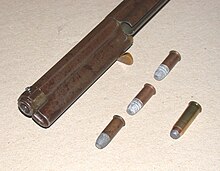
Magazine in loading position, three Henry Dull cartridges, compare with .44-40 WCF labialize
To charge the magazine, the shooter moves the cartridge-follower on the slot into the top portion of the powder store-tube and pivots IT to the right to open the in advance-remnant of the powder magazine. He loads up to 15 cartridges one by one, He pivots the elevation portion back and releases the follower.
Legacy [edit]
While never issued on a large scale, the William Henry plunder demonstrated its advantages of rapid fire close up different times in the Civil State of war and later during the wars between the Coupled States and the Plains Indians. Examples include the successes of two Henry-thorny Union regiments at the Battle of Benjamin Franklin against large Confederate attacks, as well as the Henry-armed Sioux and Capital of Wyoming's death of the 7th Horse at Little Big Tusk.
Manufactured by the New Haven Arms Accompany, the Henry rifle evolved into the famous Winchester Model 1866 lever-military action rifle. With the innovation of the spic-and-span Model 1866, the New Haven Arms Company was renamed the Winchester Repeating Munition Company.
Reproductions [edit]

Modern replica Henry reave
The orthogonal Henry Repeating Arms produces a modernized replica of the Model 1860 Henry Rifle with face telephone receiver and American walnut tree stock certificate, just a late brand barrel and internal components besides as a walnut tree forward origin.[12]
Uberti produces an almost exact copy Henry Simulate 1860 chambered in .44-40 Winchester or .45 Colt, rather than the avant-garde .44 Henry rimfire. Distributed by several companies, these replicas are popular among Cowboy Action Shooters and Civil War reenactors, also as competition shooters northwards-South Skirmish Association(N-SSA).[13] [ citation necessary ]
Imag also [edit]
- Colt Lightning Carbine
- Colt's Spick-and-span Model Revolving reave
- Spencer repeating ransack
- Rifles in the North American country Civil War
- Winchester rifle
Notes [edit]
- ^ Tales of the Gas: Guns of the Polite War. (12:34 — 12:40) Account Channel, 2001.
- ^ Butler, David F. United States Firearms The First Century 1776-1875 (New York: Winchester Press, 1971), p.229.
- ^ Butler, p. 226.
- ^ Butler, p.233.
- ^ Butler, p. 232.
- ^ a b Tales of the Gun: Guns of Winchester. (21:12 — 21:58) Story Canalize, 2001.
- ^ http://www.henryrepeating.com/history.cfm
- ^ Bresnan, Andrew L. "Chapter 7: The 'Modern Henry'". The Henry Repeating Rifle: Victory thru rapid fire. rarewinchesters.com. Retrieved 20 January 2015.
- ^ http://web.wbc.poznan.pl/Content/378496/PDF/469806.pdf
- ^ Bresnan, Andrew L. "Introduction". The Henry Repeating Rifle: Victory thru rapid fire. rarewinchesters.com. Retrieved 20 January 2015.
- ^ Bresnan, jack L. "Chapter 6: Henry Odds and Ends". The Henry Repeating Rifle: Triumph thru rapid fire. rarewinchesters.com. Retrieved 20 January 2015.
- ^ Staff (January 2014). "Henry Repeating Arms Co. Expands line and mental ability". American Rifleman. 162 (1): 32.
- ^ NSSA Approved Weapons system varlet. Archived March 5, 2009, at the Wayback Car
References [edit]
- Hartford Michigan Military machine History.
- American Rifleman, May 2008; (Henry Repeating Blazon) cave in, p. 26.
- Sword, Wiley. The Historic Henry Rifle: Oliver Winchester's Famous Civil War Repeater. Capital of Nebraska, Little Rhody : St. Andrew Mowbray Publishers, 2002.
- Compared: .357 Magazine. Joseph Henry Big Boy, Marlin 1894C and Uberti 1873 Rifles by Chuck Hawks.
Foreign links [edit]
- Henry Repeating Arms Company - web site of the innovative Henry Repeating Arms Company
- Uberti USA 1860 Henry Rifle
what would henry do when he fired his rifle
Source: https://en.wikipedia.org/wiki/Henry_rifle
